

RBI Policies & Inflation in 2025: How do they impact your home loan and EMI

102
Words
Mode:
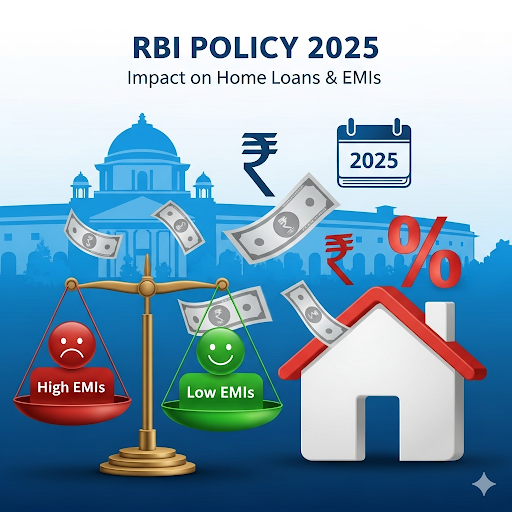
RBI Policy impact on home loan and EMI: Infographic 2025. Home with percentage symbol, balance with High EMIs (sad face-red), Low EMIs (happy face-green), rupee and money icons, calendar with date as 2025, silhoutte of RBI building in background.

If you are servicing a home loan in India, each RBI statement is perhaps akin to a “now or never” moment. A marginal cut in interest rates can either lower your EMI or enhance your monthly burden. In 2025 after the rate cuts (in the face of lingering inflation) people are anxiously waiting to see if the RBI will cut rates or hold them constant.

📌 Why RBI News is Important for Borrowers

The role of the repo rate is to control inflation and growth. The rate at which banks borrow funds from the RBI.

Banks also pass on the costs to customers when RBI increases repo rate. That translates into more EMIs for home loans.

When the RBI reduces the repo rate, banks get money at a cheaper rate and therefore these can be passed on and so can the EMI.

For lakhs of Indian families who have availed of long-term housing loans, this makes RBI’s monetary policy a very personal matter.

(Embed infographic: “Repo Rate ↑ = EMI ↑ | Repo Rate ↓ = EMI ↓”)

📌 Inflation in 2025 – The Main Driver

India has inflation around 5–6% or 2025. It may not be a very high number, but for the R.B.I., it is crucial.

When the prices of essentials such as food, fuel, and housing go up, the RBI tightens monetary policy by ensuring that interest rates stay high. The hope is that it will reduce spending and cool inflation. But this has direct consequences for borrowers, who often end up paying more on loans.

On the other hand, if inflation comes in lower, say more in the 4-5% ballpark, the RBI gets more room to cut rates. Which brings us to the silver lining for home loan borrowers.

📌 Will RBI Cut Rates in 2025?

The question in everyone’s mind is quite straightforward: Will my EMI go down now?

Experts think there is a very good chance of a rate cut in 2025 if there isn’t a blowup in inflation. A slight reduction, of 0.25 percent to 0.50 percent, can still translate to big savings. For instance, on a ₹40 lakh loan taken for 20 years, such a cut could help borrowers save thousands of rupees a year.

But there’s also a risk. If global crude prices surge, or there is a spurt in food inflation, the RBI could be prompted to maintain or raise rates.

📌 What Borrowers Should Do

For existing loans Watch out for RBI announcements. If rates have come down, consider refinancing or transferring balance to lower EMI.

In the years to come: If you are a prospective home buyer, it may be golden in 2025 if rates fall. Lower EMI during these times will secure more and more savings in the long run.

Be ready: Have a financial cushion in place at all times, because rates can go up suddenly.

Image Description: A happy Indian family sitting together at home and smiling with happiness, representing financial assistance. Over it is a bold text that reads “Lower EMIs = More Savings”, reflecting RBI's slashing rates and giving a boost to home loans and monthly budget.

✅ Final Thoughts

The decisions thatPolice is making may sound wonkish, but their consequences are very real for people.In any case, those poor people don’t deserve this punishment. Each reduction that slashes your EMI is a relief for families. Each increase exerts pressure on the monthly budget. As 2025 unfolds, all eyes will be on the RBI. Lowering the rates could provide a much-needed relief that would help millions of Indians better afford their homes.


SIP Boom in India 2025: Why Indians Invest in SIP Over FD & Gold for Long-Term Investment?

102
Words
Mode:
More than 80 percent of Indian women check investments on their mobile phones in formal dress, whereas less than 30 percent of women in the United States do so. Three visuals appear behind her, depicting the options - a shiny pile of coins signifying SIP growth, a stack of gold jewelry depicting gold investment, a bank passbook showing fixed deposit. Text overlay appears, “SIP > FD & Gold – Future of Wealth 2025.”

When it comes to investing and saving, most Indian households have had their money primarily in Fixed Deposits (FDs) or Gold. In the 80s, FDs were perceived as safe and risk-free, while gold was seen as an asset that will not lose value and could be inherited by the next gen. But 2025 has revealed a major change—large numbers of Indians are heading on the path to Systematic Investment Plans (SIPs) when it comes to mutual funds SIP.

The change isn’t a fad, not at all. In a true sense, SIPs are turning to be a No.1 option as far as mutural funds investment for long term are concerned in India and there are substantial reasons for it s transformation.

Why SIPs investment Are Booming in 2025

Accessibility and Flexibility

Unlike FDs and gold, sip does not require a huge lump sum to start. Even novices can begin with as little as ₹500 a month. This has made SIPs a hit among young professionals and students who wish to start small but dream big.

Better Returns Over Time

On the average you may get a 5-7% returns from the FDs and gold, in the range of 6-8%. On the other hand, equity mutual funds via SIPs Investment have yielded 12-15% returns in the long term. That is a huge gap if you’re thinking in terms of a 10–15 year time horizon.

Compounding Advantage

The compounding magic is best extracted from investment. The power of investing small amounts over time is that your returns begin to earn returns. Over the long run this snowballs into a very powerful wealth creation machine—a power well beyond what an FD or gold can offer.

Inflation-Beating Growth

India’s inflation hovers around 6%. Unfortunately, both FDs along with gold more often than not do not exceed this rate in real terms. SIPs, meanwhile, offer real growth after inflation, and can make investors richer, not just richer in relative terms.

SIP vs FD vs Gold: A swift Comparison

SIP (Systematic Investment Plan): Ideal for long-term wealth creation, financial goals, and retirement planning. There’s other stuff in there, all kinds of application, but averaging over time, being linked to markets, reduces risk.

FD (Fixed Deposit): Safe and secure, but low returns. Appropriate for emergency savings and other very short-term needs.

Gold: A hedge in uncertain times, good for diversification, but a poor, independent way to build wealth.

In 2025, Why Indians Have Opted For long term investment

Presented by Association of Mutual Funds in India, SIP flow in 2025 reached an all-time high of ₹22000 crores per a month. This demonstrates the confidence that Indians now have in mutual funds.

Apps and awareness campaigns have made it a cakewalk to invest in Long term Investment through digital platforms and UPI-based investment. Why, young investors, in particular, love the investment is because they view it as disciplined yet flexible approach to financial freedom.

Final Thoughts

FDs and gold have their own place in a portfolio, but for long term goals like retirement, buying a house or children’s education, SIPs are evident winners. They are plain, potent and meant to aid Indians in accumulating wealth over the long term.

In brief ,sip investment are not only a recent fad but the future of investment in India.